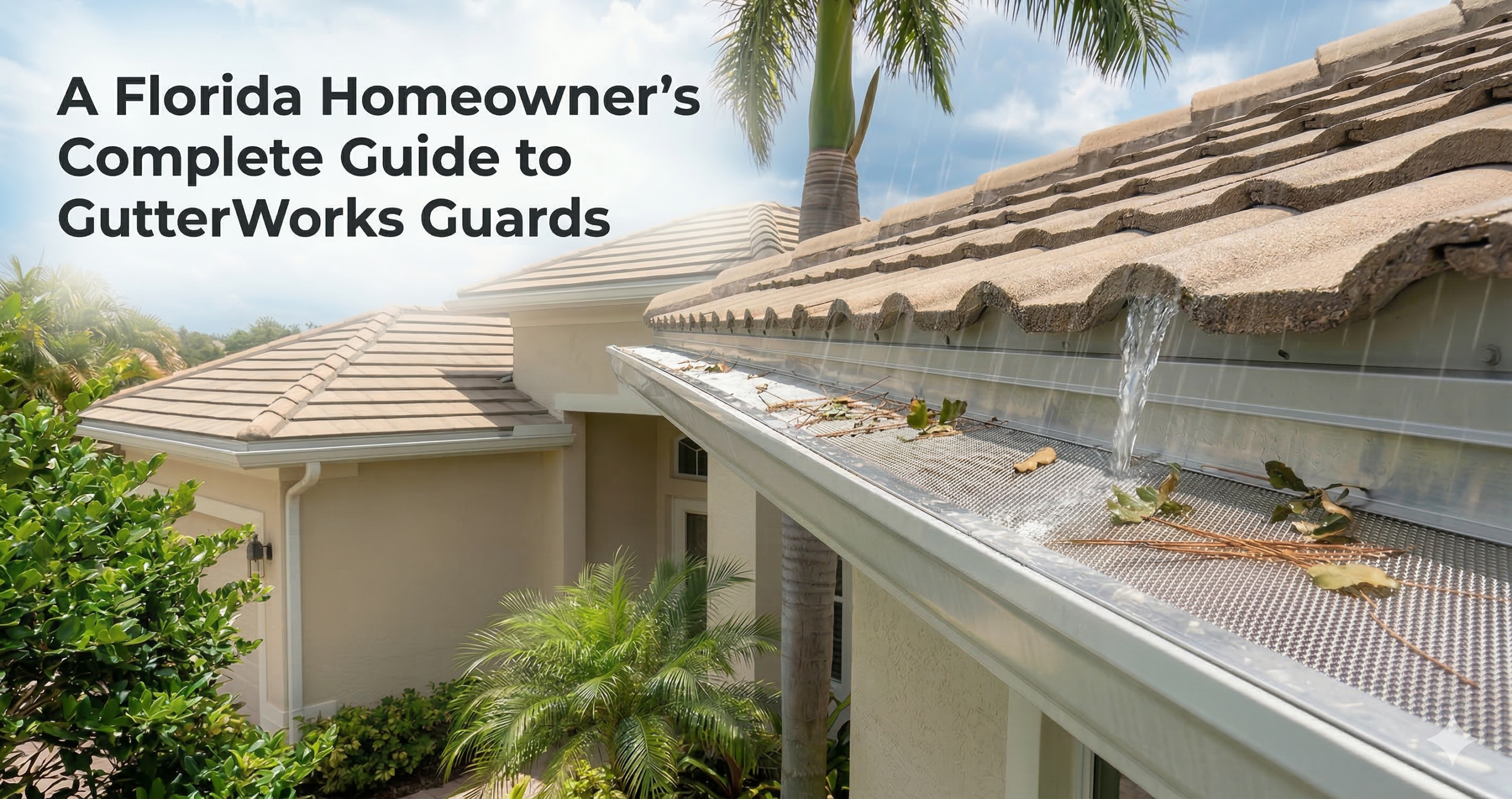
Florida dumps more than 50 inches of rain on your roof every year. Most of that comes in violent afternoon thunderstorms that can drop two to four inches in a single hour. If you’ve ever watched water cascade over the sides of your gutters during a summer downpour—pooling around your foundation, flooding your flower beds, splashing against your front door—you already know the problem.
So do gutter guards actually work? The short answer is yes. But the longer, more honest answer is that the right type of gutter guard, properly installed, works extremely well—while the wrong type can waste your money or create new headaches.
At GutterWorks, we’ve spent over 20 years installing, repairing, and replacing gutter systems across Central Florida. We’ve seen what holds up in Orlando’s climate and what doesn’t. This guide breaks down the six main types of gutter guards, what each one costs, and which ones are actually worth it for Florida homeowners.
What Are Gutter Guards and How Do They Work?
Gutter guards are protective covers or screens installed over your existing gutters that block leaves, pine needles, and other debris while allowing rainwater to flow through into the gutter channel.
The concept is straightforward. A barrier sits on top of your open gutter trough and acts as a filter. Water passes through or over the guard and into the channel below. Debris—leaves, twigs, seedpods, pine straw—stays on top and either blows off with the wind or slides to the ground.
That’s the theory. In practice, performance depends heavily on the guard type, the mesh size, the installation angle, and your specific environment. A guard that works perfectly on a home in North Carolina might fail completely on a home in Winter Park surrounded by slash pines and live oaks. Florida’s combination of intense rainfall, year-round debris, and brutal UV exposure puts gutter guards to a test that most manufacturers don’t design for.
6 Types of Gutter Guards Compared
1. Micro-Mesh Guards
These are the top performers for Florida homes. Micro-mesh guards use a fine stainless steel screen—typically 275 microns, roughly the gauge used in surgical instruments—stretched over an aluminum frame. The mesh is fine enough to block pine needles, oak pollen, roof grit, and even sand while still handling heavy water flow.
Cost runs $6 to $12 per linear foot installed. That’s a real investment, but the performance justifies it for most Florida homeowners. This is the same technology behind national brands like LeafFilter. The stainless steel construction also holds up against Florida’s UV and humidity far better than plastic or foam alternatives.
2. Screen Guards
Screen guards are the budget-friendly option. Made from aluminum or plastic with larger openings than micro-mesh, they catch big debris like leaves and twigs but let smaller particles through. Pine needles are a problem—they wedge into the screen holes and create clogs.
At $1 to $3 per foot, screens make sense as a starter solution for homeowners on a tight budget. Just know you’ll still need to clean them a couple of times a year, especially if you have pines or oaks nearby.
3. Reverse Curve (Surface Tension) Guards
These guards use the principle of water surface tension. Water clings to the curved surface and flows into a narrow slot while leaves and debris slide off the edge. They look sleek and they work well—in the right conditions.
Florida often isn’t the right conditions. Reverse curve guards struggle with Spanish moss, which drapes over the curve and blocks the slot. Palm fronds jam against the opening. And during heavy downpours—the kind we get every summer afternoon—water can sheet right over the curve and miss the slot entirely. At $15 to $25 per foot installed, that’s an expensive gamble in our climate.
4. Mesh Guards
Standard mesh guards sit between screens and micro-mesh in both performance and price. They use a metal or plastic mesh with openings smaller than screen guards but larger than micro-mesh. They handle leaves and larger debris reasonably well but can still let fine particles like pollen and roof grit through.
Expect to pay $3 to $6 per foot. They’re a solid middle-ground option for homeowners who don’t have heavy pine needle problems.
5. Foam Insert Guards
Foam guards are triangular blocks of polyurethane foam that wedge directly into your gutter trough. Water filters through the foam while debris sits on top. They’re cheap ($2 to $4 per foot) and easy to install yourself.
Here’s the problem: we don’t recommend foam guards for Florida. The combination of UV exposure and humidity breaks down the foam in two to three years—sometimes faster. We’ve pulled out foam inserts that had turned into crumbling, mold-covered sponges after a single Florida summer. The foam traps moisture instead of shedding it, which creates a breeding ground for mold and algae right inside your gutter. Save your money.
6. Brush (Bottle Brush) Guards
Brush guards are cylindrical bristle inserts that sit inside the gutter channel. Debris lands on top of the bristles while water flows through. They’re affordable ($3 to $5 per foot) and require no fasteners—you just lay them in.
The drawback? Debris doesn’t just sit on top. It works its way down into the bristles and gets trapped. In Florida, where debris falls year-round, brush guards need frequent cleaning—sometimes more often than unguarded gutters. They can work as a temporary solution, but they’re not a long-term answer for our climate.
| Type | Best For | Cost/Ft | FL Rating | Pine Needles? | Heavy Rain? | Lifespan | Maintenance |
|---|---|---|---|---|---|---|---|
| Micro-Mesh | Whole-home protection | $6–$12 | ★★★★★ | Yes | Yes | 20+ yrs | Annual |
| Screen | Budget homes | $1–$3 | ★★★ | No | Moderate | 10–15 yrs | 2–3x/yr |
| Reverse Curve | Low-debris areas | $15–$25 | ★★ | No | Poor in heavy rain | 20+ yrs | 1–2x/yr |
| Mesh | Mixed debris | $3–$6 | ★★★ | Partial | Moderate | 15–20 yrs | 1–2x/yr |
| Foam Insert | Not recommended for FL | $2–$4 | ★ | No | Poor | 1–3 yrs | Frequent |
| Brush | Temporary fix | $3–$5 | ★★ | No | Moderate | 5–10 yrs | 3–4x/yr |
Do Gutter Guards Work in Florida? What Makes Our Climate Different
This is where most online guides fall short. They give you generic advice written for a house in Ohio or Virginia. Florida is a different animal entirely.
Rainfall intensity matters more than rainfall totals. Yes, we get 50-plus inches a year. But the real challenge is how that rain arrives. A summer thunderstorm can dump two to four inches in a single hour. Standard gutter guards designed for gentle, steady rainfall can be completely overwhelmed. Water sheets over the top, and your gutters might as well not exist. Any guard you install needs to handle high-volume flow without overrunning.
The debris never stops. In most of the country, leaves fall in autumn and you’re done until next year. In Central Florida, something is always dropping. Slash pines shed needles year-round. Live oaks dump pollen and tiny leaves in massive volume every spring. Spanish moss catches on everything. Palm fronds break off after every storm. And twice a year, love bug season coats your roof and gutters in a sticky mess that can clog fine mesh. Your gutter guards need to handle all of it—not just one type of debris.
UV and humidity destroy cheap materials fast. Plastic and foam products that might last five to seven years up north degrade in half that time here. Florida’s UV index regularly hits 10 or higher, and our humidity hovers between 70 and 90 percent for months at a stretch. Stainless steel and aluminum are the only materials we trust for long-term performance in this climate.
Hurricanes and tropical storms test every fastener. Poorly secured gutter guards can peel off in high winds—or worse, become airborne debris that damages your roof, your neighbor’s car, or your pool enclosure. Any guard installed in Florida needs to be mechanically fastened, not just clipped on.
Pool enclosures add a wrinkle. Millions of Florida homes have screen enclosures with integrated super gutter systems. These specialized structural gutters are wider and thicker than standard residential gutters, and off-the-shelf gutter guards usually don’t fit them. If you have a pool cage or screened lanai, talk to a specialist before buying any gutter guard product.
Clogged gutters are a mosquito factory. This one doesn’t get enough attention. Mosquitoes can breed in as little as a tablespoon of standing water. A gutter clogged with leaves and debris after a rainstorm becomes a perfect incubator—warm, stagnant, hidden from view. In a state where mosquito-borne illnesses like West Nile and Eastern Equine Encephalitis are real public health concerns, keeping your gutters flowing freely isn’t just about protecting your house. It’s about protecting your family. Gutter guards won’t eliminate every mosquito in your yard, but they remove one of the biggest breeding sites on your property.
Seasonal timing matters here more than anywhere. Florida’s rainy season runs roughly June through September, with the heaviest storms concentrated in July and August. Hurricane season overlaps from June through November. A practical Florida gutter guard maintenance calendar looks like this: inspect and clear guards in late May before the rain hits, do a quick check after any major storm or hurricane, and do a thorough inspection in October or November once the worst of the rain and wind has passed. If you have live oaks, add a spring check—pollen drop in March and April can coat mesh guards and reduce water flow.
Pros and Cons of Gutter Guards (Honest Assessment)
| PROS | CONS |
|---|---|
| ✓ Reduce cleaning by 80–90% | ✗ Still need annual inspection |
| ✓ Prevent $5,000+ water damage repairs | ✗ $800–$2,500 upfront investment |
| ✓ Deter mosquitoes and pest nesting | ✗ Wrong type = wasted money |
| ✓ Eliminate risky ladder climbs | ✗ Poor install causes water bypass |
| ✓ Extend gutter lifespan | ✗ Some types void gutter warranty |
| ✓ Keep rodents and birds out |
No gutter guard eliminates maintenance entirely. But the right guard, properly installed, turns a four-times-a-year chore into an annual checkup. For most Florida homeowners, that trade-off is worth it.
How Much Do Gutter Guards Cost in Florida?
Most gutter guard articles dodge the pricing question. We’d rather be upfront.
Here’s what you can expect to pay per linear foot, installed:
- Screen guards: $1 to $3
- Foam inserts: $2 to $4 (DIY)
- Mesh guards: $3 to $6
- Brush guards: $3 to $5 (DIY)
- Micro-mesh guards: $6 to $12
- Reverse curve guards: $15 to $25
The average Florida home has 150 to 200 linear feet of gutter. That puts the total project cost somewhere between $800 and $2,500 depending on the guard type you choose and your home’s layout.
What affects the final price? A two-story home costs more because of the added labor and safety equipment. Gutters in poor condition may need repair or replacement before guards can be installed. Complex rooflines with lots of corners and valleys take longer. Homes with pool enclosures or screen cages may require specialized guards.
The ROI math works in your favor. Professional gutter cleaning in the Orlando area runs $150 to $300 per visit. If you’re cleaning two to four times a year, that’s $600 to $1,200 annually. Gutter guards pay for themselves in one to three years—before you even factor in the cost of water damage repairs you’ve avoided.
Ready to find out what gutter guards would cost for your home? Get a free estimate from GutterWorks—no pressure, no obligation.
A note on insurance and warranties. Some homeowners ask whether gutter guards affect their homeowner’s insurance. The short answer is that most insurers won’t raise or lower your premium based on gutter guards alone. However, if clogged gutters cause water damage and your insurer determines you neglected basic home maintenance, that claim could be denied or reduced. Gutter guards are evidence of proactive maintenance—which works in your favor. On the warranty side, check with your gutter manufacturer before installing guards. Some manufacturers specify that only certain guard types are compatible, and installing the wrong product can void your gutter warranty.
How to Choose the Right Gutter Guards for Your Home
Every home is different. Here’s a quick decision guide based on what we see most often across Central Florida:
If you have pine trees near your roofline: Micro-mesh is your best option. The fine screen keeps needles out without restricting water flow.
If you need a budget-friendly solution: Start with aluminum screen guards and plan on cleaning them once or twice a year. It’s not perfect, but it cuts your maintenance significantly.
If you have a pool cage or screen enclosure: Don’t buy anything off the shelf. Standard guards won’t fit super gutter systems, and a bad fit can cause structural problems. Get a professional assessment first.
If you want the closest thing to “set and forget”: Invest in professionally installed micro-mesh guards. You’ll still want an annual inspection, but day-to-day maintenance drops to almost zero.
If your gutters are already in rough shape: It may make more sense to replace your gutters and install guards at the same time. Putting guards on failing gutters is like putting a new roof on a rotting frame.
One more thing: gutter size matters. Five-inch and six-inch gutters require different guard sizes. Make sure whatever you buy is rated for your gutter profile—or have a professional measure and fit them.
Professional Installation vs. DIY Gutter Guards
Some gutter guards are genuinely DIY-friendly. Foam inserts, brush guards, and certain snap-on screen products can be installed by a handy homeowner with a ladder and an afternoon—especially on single-story homes with straight gutter runs. If you’re comfortable on a ladder and your roofline is simple, these products can save you a few hundred dollars in labor.
Professional installation is the better call when you’re choosing micro-mesh or reverse curve guards, when your home is two or more stories, when you have complex rooflines with multiple valleys and corners, or when your home has a screen enclosure or pool cage. These situations involve precision fitting, safety equipment, and—in many cases—knowledge of how your gutter system integrates with other structural elements like fascia boards and roof drip edges.
Why does professional installation matter more in Florida than in most states? Three reasons. First, your gutters need the correct slope to handle our downpours—too flat and water pools inside the trough, too steep and it overshoots the downspouts. Getting that pitch right takes experience. Second, every fastener needs to withstand tropical storm-force winds. A guard that peels off in a storm is worse than no guard at all—it becomes a projectile. Third, Florida building codes govern gutter attachments, and a licensed installer knows those codes inside and out.
There’s also the warranty factor. Many gutter guard manufacturers require professional installation for the warranty to be valid. If you install micro-mesh guards yourself and a seam fails two years later, you may have no recourse. A professional installation typically comes with both a product warranty and a workmanship guarantee.
GutterWorks fabricates gutter systems on-site with custom measurements. We’re licensed, insured, and we’ve seen what a Florida summer does to every guard type on the market. That experience—knowing which products hold up in Oviedo’s oak canopy neighborhoods versus Kissimmee’s open-lot developments—is part of what you’re paying for.
Signs You Need Gutter Guards
Not sure if gutter guards are right for your home? If any of these sound familiar, they probably are:
- You’re cleaning your gutters three or more times a year and it’s eating your weekends
- Water overflows your gutters during rainstorms, even moderate ones
- You’ve noticed cracks in your foundation or erosion in the landscaping around your downspouts
- Pine trees, oaks, or palms sit within 20 feet of your roofline—close enough to drop debris directly into open gutters
- You’ve found mosquitoes breeding in standing gutter water, or rodents and birds nesting in debris buildup
- You or a family member has had a close call on a ladder while cleaning gutters—falls from ladders send more than 500,000 Americans to the emergency room every year
- Your gutters sag or pull away from the fascia because of debris weight and clogs
- You’ve already dealt with water damage to your foundation, fascia, or soffit and want to prevent it from happening again
If you checked two or more of those boxes, gutter guards are worth a serious look. If you checked four or more, they’re close to essential.
Frequently Asked Questions About Gutter Guards
Protect Your Home with Professional Gutter Guard Installation
Gutter guards work. They work especially well in Florida when you choose the right type for your home’s specific conditions—and when they’re installed by someone who understands what Central Florida weather does to building materials.
GutterWorks has been Orlando’s trusted gutter specialist for over 20 years. We’re a family-owned business, fully licensed and insured, and we fabricate custom gutter systems on-site. Every project starts with a free, no-pressure estimate where we assess your home, your roof, your trees, and your gutter condition—then recommend the solution that actually fits your situation.
Schedule Your Free Gutter Guard Consultation or call us at (407) 960-9489. We serve Orlando, Winter Park, Lake Nona, Oviedo, Kissimmee, and communities across Central Florida.
Not sure you need gutter guards? Start with our guides on why gutters matter for your home or how often you should clean your gutters.